*This audit was conducted by Mighty Kind CIC between 02/10/2026 and 23/10/2026, with full credit given to our volunteer, Esther Ibrahim.
Executive summary
Nearly four in five active UK-based charities serving visually impaired people have websites that fail basic colour contrast accessibility standards, the very standards designed to ensure visually impaired people can read digital content.
Mighty Kind CIC audited 112 active registered UK charities, based in England, whose Charity Commission registration includes the term "blind". Every charity with a functional website was tested using WAVE, the industry standard web accessibility evaluation tool against WCAG 2.1 AA colour contrast requirements. These requirements are legally mandated under the Equality Act 2010.
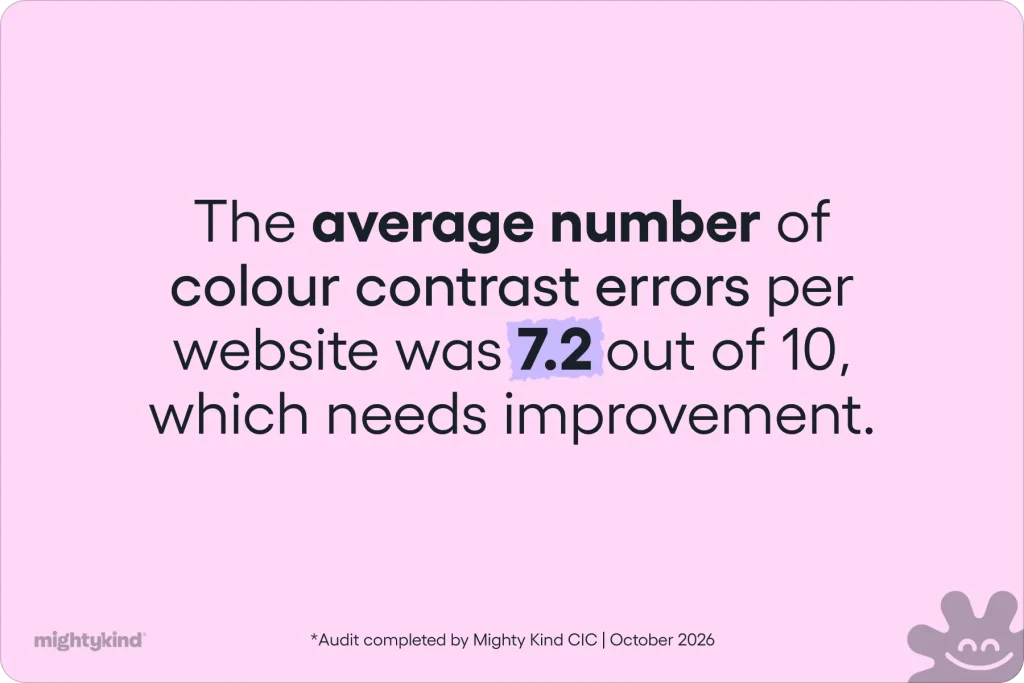
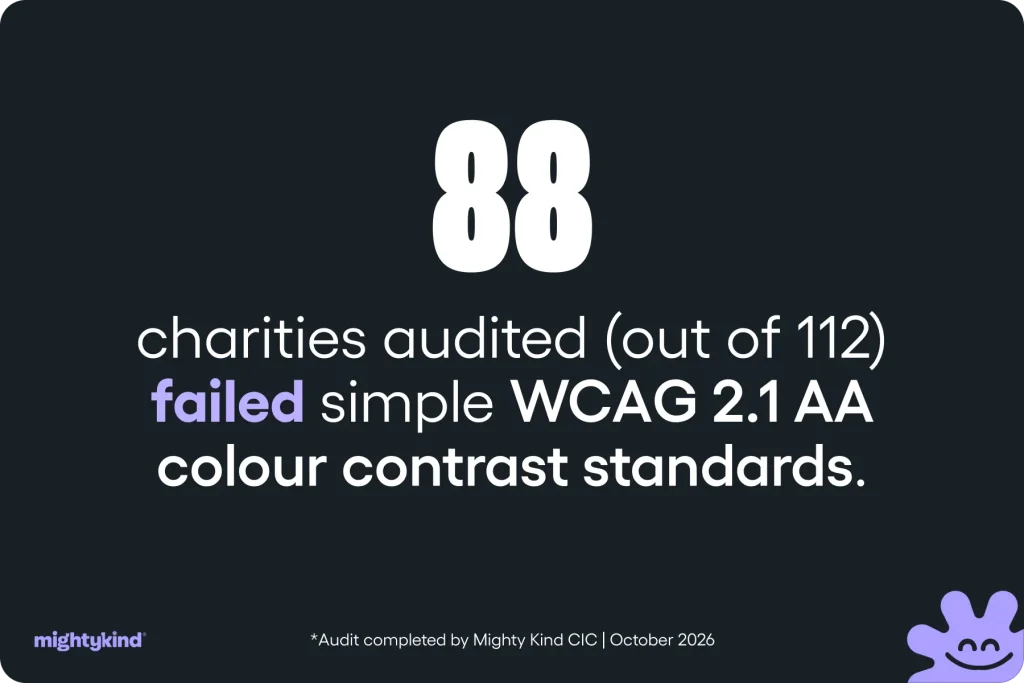
Our audit of 112 charities with accessible websites found that 79% (88 charities) failed to meet WCAG 2.1 AA colour contrast standards.
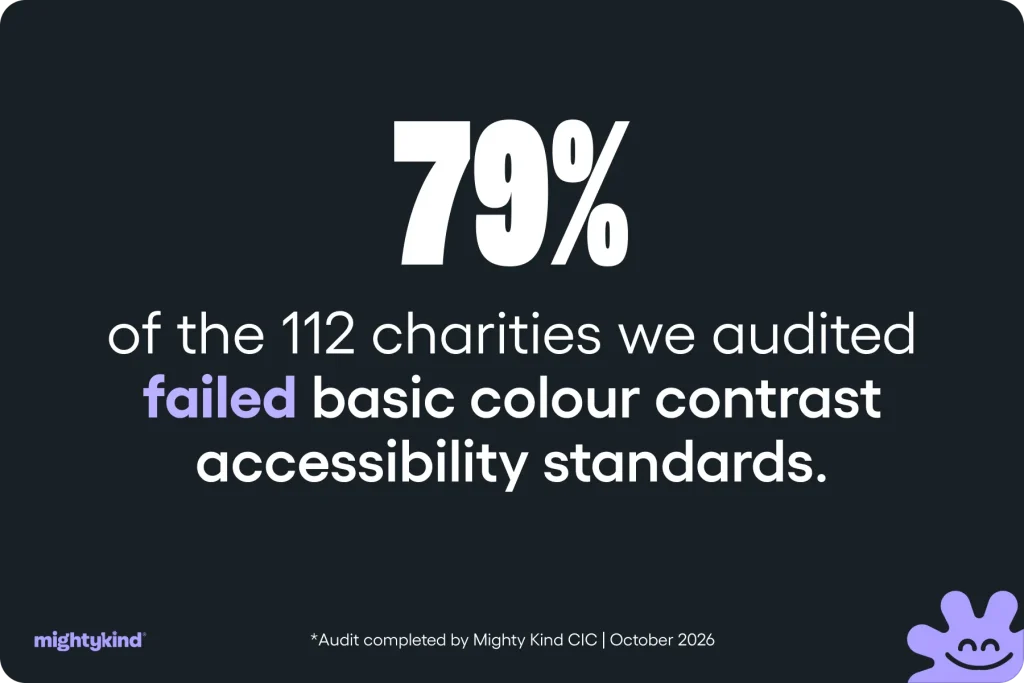
The average number of colour contrast errors per website was 7.2. One charity recorded 82 contrast errors on a single homepage. Major national organisations were not exempt; Guide Dogs, one of the UK’s most recognisable charities, recorded contrast failures despite having a professional web team and significant resources.
The findings reveal a sector-wide blind spot. The organisations most responsible for understanding the digital needs of visually impaired people are among those least likely to meet them.
Why this audit matters
More than two million people in the UK are living with sight loss, according to RNIB. For many of them, digital access is not a convenience; It's how they find support, connect with services and access information about organisations that exist to help them.
Colour contrast is one of the most fundamental accessibility requirements. Research published in the Review of Optometry confirms that higher contrast significantly improves readability for people with conditions like glaucoma, one of the leading causes of sight loss in the UK.
The Web Content Accessibility Guidelines (WCAG) 2.1 Level AA, referenced in the UK Government’s Service Manual, require a minimum colour contrast ratio of 4.5:1 for normal text. Failing to meet this standard is more than a design flaw; it creates a barrier that can prevent people from accessing essential information. Under the Equality Act 2010, organisations providing services to the public have a legal duty to make reasonable adjustments for disabled people. Websites with insufficient colour contrast may therefore exclude people with visual impairments and, depending on the circumstances, could indicate a failure to meet these legal obligations.
The WebAIM Million 2026 report found that low-contrast text was the most common accessibility failure across one million websites worldwide, affecting 81% of pages tested. Our findings suggest that charities supporting visually impaired people are not exempt from this widespread problem, with some recording failure rates that exceed the global figure.
Methodology
Data source: Active registered charities in England whose Charity Commission registration includes the term “blind”. Data was sourced from the Charity Commission for England and Wales register via Find That Charity (findthatcharity.uk).
Scope: All active registered charities with a functional website were considered. Charities without a website, with expired domains, or whose websites could not be accessed or scanned by either tool were excluded from the main dataset and recorded separately.
Tools: Websites were audited using WAVE (Web Accessibility Evaluation Tool), developed by WebAIM, with findings cross-checked using the Silktide Accessibility Checker where possible.
Standard: Audits assessed compliance with WCAG 2.1 Level AA colour contrast requirements, as referenced in the UK Government Service Manual. These guidelines provide a benchmark for assessing accessibility, alongside the relevant duties under the Equality Act 2010.
Scan mode: Each website was scanned in its default display mode, without activating accessibility settings, alternative colour schemes or other customisation features. This approach reflects the experience of a user with visual impairments visiting the website for the first time, before making any adjustments.
Accessibility Improvement Measure (AIM) scores: The average overall WAVE Accessibility Improvement Measure (AIM) score across the 112 charities audited was 7.6 out of 10. This provided an additional measure of overall page accessibility beyond colour contrast alone.
Key findings
79% of charities audited failed WCAG 2.1 Level AA colour contrast standards.
Of the 112 active English charities supporting visually impaired people with functional websites, 88 had at least one colour contrast failure on their homepage.
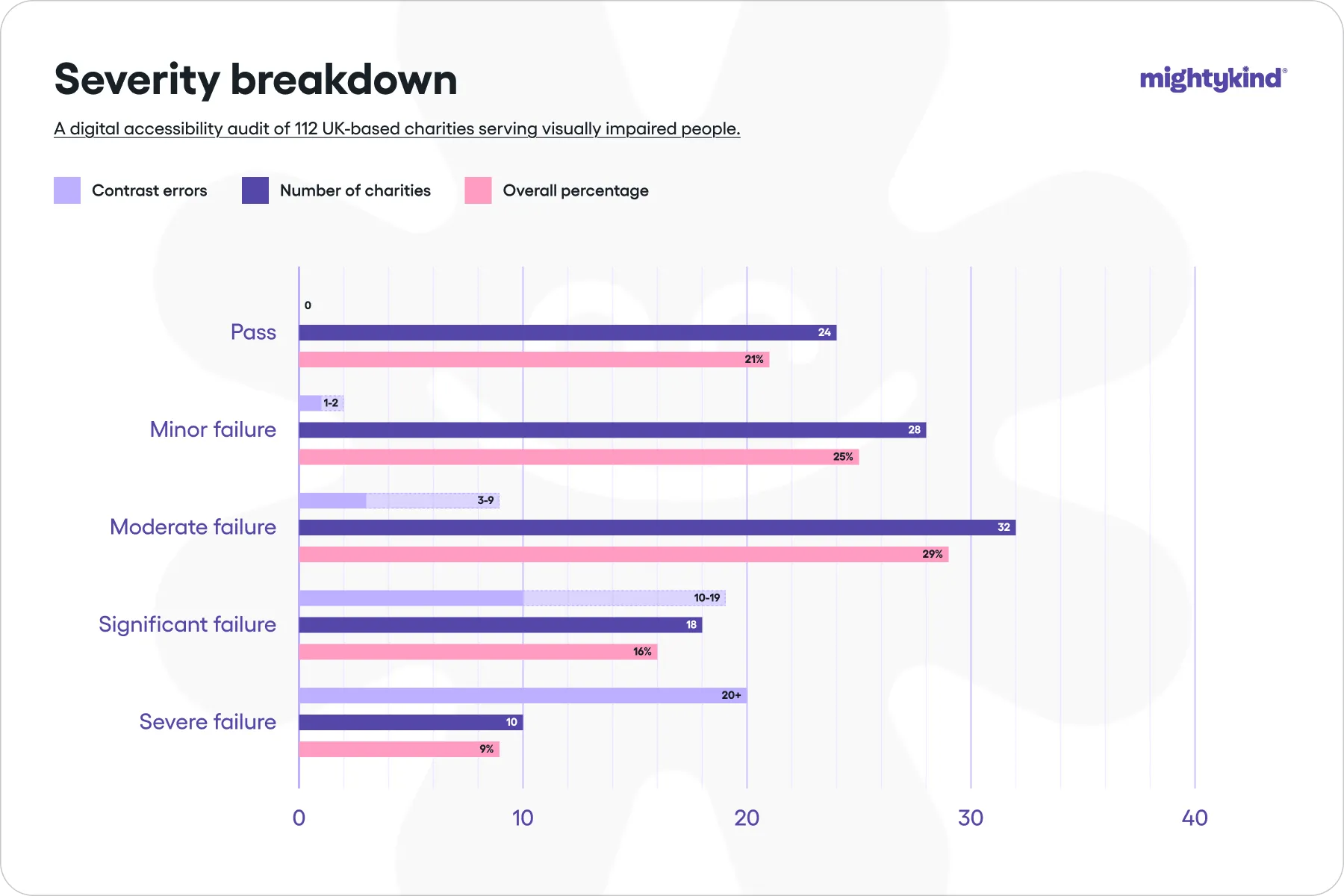
Severity breakdown:
| Category | Contrast errors | Number of charities | Percentage |
|---|---|---|---|
| Pass | 0 | 24 | 21% |
| Minor failure | 1 to 2 | 28 | 25% |
| Moderate failure | 3 to 9 | 32 | 29% |
| Significant failure | 10 to 19 | 18 | 16% |
| Severe failure | 20 or more | 10 | 9% |
*Average contrast errors per website: 7.2
Notable findings:
- Global findings: The WebAIM Million 2026 report found that low-contrast text was the most common web accessibility failure, affecting 81% of the one million websites tested worldwide.
- Charity sector findings: Our audit suggests that charities supporting visually impaired people reflect this global pattern, with some recording even higher rates of colour contrast failures.
- Key concern: Charities serving visually impaired people are not exempt from the accessibility barriers affecting websites more broadly.
Charities that failed our audit
The following charities recorded the highest number of colour contrast failures in our audit. They are named not to shame but to illustrate the scale of the problem and to encourage improvement. These organisations do amazing work, and we'd love to help!
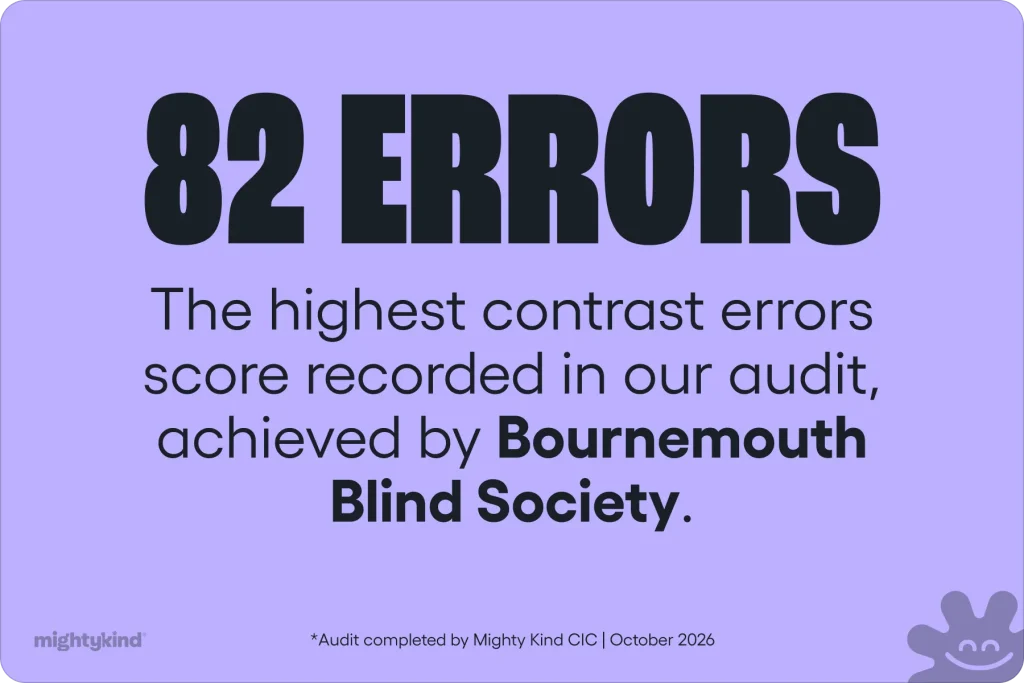
Bournemouth Blind Society - 82 contrast errors
The highest score recorded in our audit. A charity serving visually impaired people in Bournemouth with 82 elements on their homepage failing basic colour contrast standards.
KAB Kent Association for the Blind - 40 contrast errors
A significant regional blindness charity with 40 contrast failures on their homepage.
Bury Tandem Club - 30 contrast errors
A charity providing cycling experiences specifically for visually impaired riders and their sighted partners. 30 contrast failures on a site built around inclusive sport.
SRSB Sheffield Royal Society for the Blind - 21 contrast errors
A long-established Sheffield institution serving visually impaired people with 21 contrast failures.
Blind in Business - 13 contrast errors
A charity supporting visually impaired people in employment with 13 contrast failures.
Blind at Sea - 16 contrast errors
16 contrast failures on the homepage of a charity serving visually impaired seafarers.
Guide Dogs - 3 contrast errors
One of the UK’s most recognisable charities with a professional web team and significant resources still recording contrast failures. This demonstrates that the problem is not limited to smaller organisations.
Our recommendations
For charities that failed: Run a free accessibility check on your website today using WAVE at wave.webaim.org. Colour contrast failures are among the easiest accessibility issues to fix. Many can be resolved by a web developer in a single session by adjusting text and background colour values.
For charity trustees and boards: Include digital accessibility as a standing agenda item in governance meetings. A website that excludes the people your charity serves is a reputation and legal risk, as well as a mission failure.
For funders and commissioners: Consider making WCAG 2.1 AA compliance a condition of grant funding for charities serving disabled people.
Legal context
The Equality Act 2010 requires organisations providing services to the public to make reasonable adjustments to ensure disabled people can access those services. The UK Government’s own service manual references WCAG 2.1 AA as the accessibility standard organisations should meet.
A website that visually impaired people cannot read due to insufficient colour contrast may constitute a failure of the reasonable adjustment duty under the Act.
Mighty Kind CIC is not a legal authority and this report does not constitute legal advice. Organisations concerned about their legal obligations should seek appropriate guidance.
About Mighty Kind CIC
Mighty Kind CIC is a creative support organisation providing affordable branding, design, marketing, photography, videography, and digital support to UK charities and grassroots organisations. We believe good causes deserve good creative support.
The Blind Spot audit was conducted as part of our mission to help charities become more visible, accessible and effective in reaching the people they exist to serve.
Interested in us? Get in touch at www.mightykind.org.uk/contact
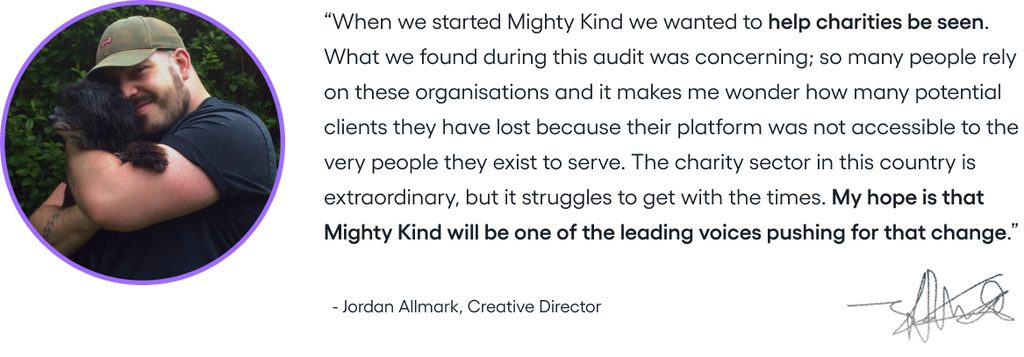
Note from our founder
References
- Review of Optometry — Higher Contrast Larger Font Helpful for Those with Glaucoma: www.reviewofoptometry.com/article/higher-contrast-larger-font-helpful-for-those-with-glaucoma
- GOV.UK Service Manual — Understanding WCAG 2.2: www.gov.uk/service-manual/helping-people-to-use-your-service/understanding-wcag
- WebAIM Million 2026 Report: www.webaim.org/projects/million
- RNIB — Key Information and Statistics on Sight Loss in the UK: www.rnib.org.uk/professionals/research-and-data/key-information-and-statistics-on-sight-loss-in-the-uk
- Equality Act 2010: www.legislation.gov.uk/ukpga/2010/15/contents